
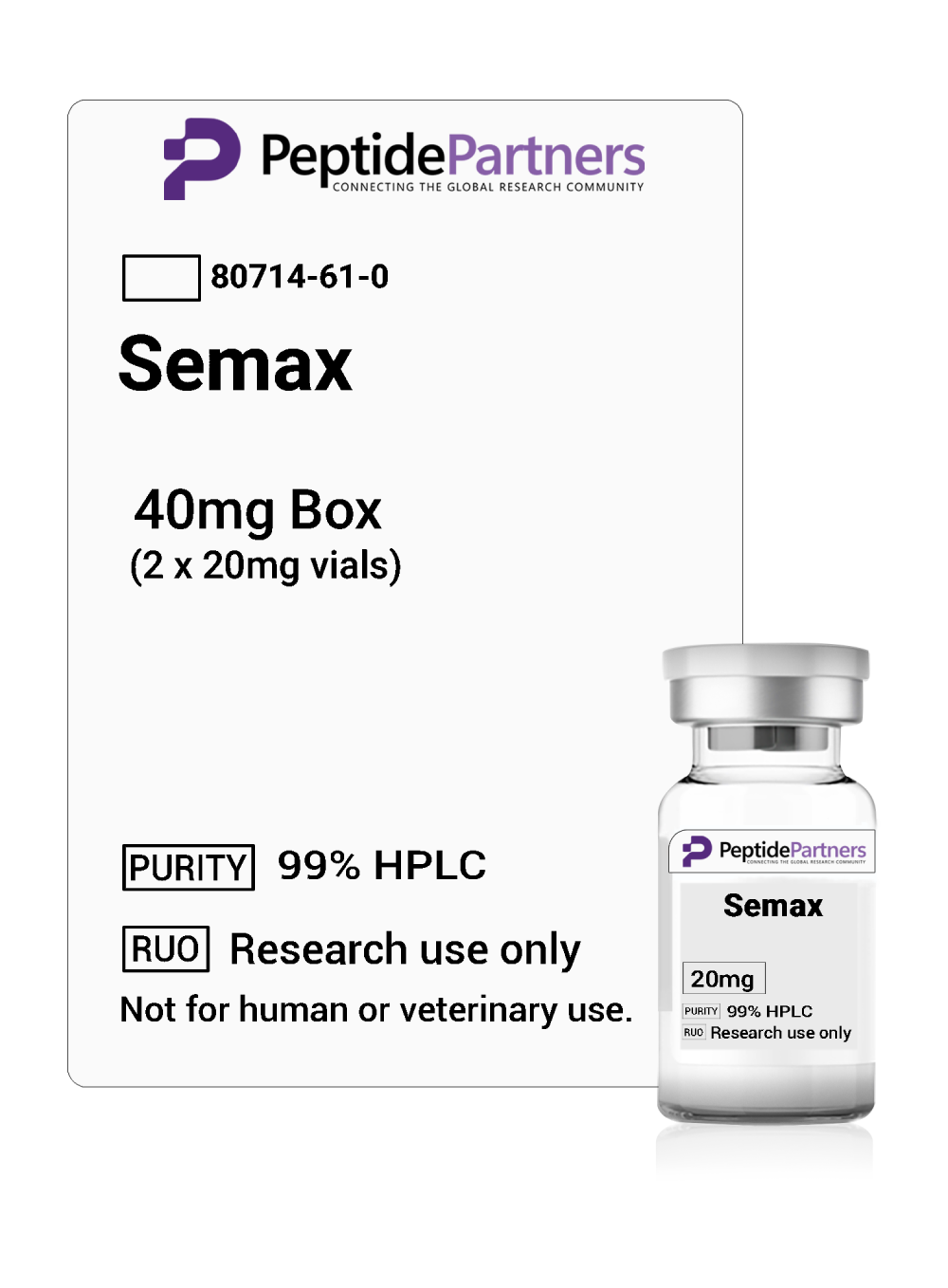

Semax (20mg vials)
Price range: $60.00 through $230.00
• Purity: 99.91% (multi-vial, independently tested)
• Format: 20mg vials (3 mL capacity)
• Box Options: 40mg, 100mg, 200mg combinations
• Testing Status: Endotoxin, heavy metals & purity screening PASSED
• Cost Efficiency: $1.15 – $1.50 per milligram
Semax is a synthetic heptapeptide analog of adrenocorticotropin (ACTH 4–10) investigated for its nootropic properties, neurotrophin modulation, and neuroprotective mechanisms in preclinical research. This research-grade material supports in-vitro experimentation focused on BDNF protein regulation, dopaminergic and serotonergic system activation, neurotrophin gene transcription, and ischemic injury models.
- Independent certificate details, manufacturer IDs, and batch IDs should be reviewed before purchase when available.
- Order cancellations for full refunds are available before shipment; shipped orders cannot be cancelled or refunded.
- For damaged or incorrect goods, photograph the outer packaging, inner packaging, and product labels, then email support within 48 hours of carrier delivery.
Buy Semax – Peptide Partners
Product Overview & Specifications
Semax is a synthetic heptapeptide analog of adrenocorticotropin (ACTH 4–10) investigated for its nootropic properties, neurotrophin modulation, and neuroprotective mechanisms in preclinical research. Peptide Partners supplies this research-grade material for in-vitro testing, laboratory experimentation, receptor pharmacology, structural biology, and preclinical neuroscience research.
Published studies have examined Semax using rat basal forebrain models, rodent dopaminergic and serotonergic system analyses, cerebral ischemia (pMCAO) models, radioligand binding assays, ELISA protein quantification, HPLC neurotransmitter measurements, and RT-PCR gene expression profiling. Research areas include BDNF protein regulation, specific peptide binding site characterization, dopamine and serotonin turnover modulation, neurotrophin gene transcription activation, and ischemic neuroprotection mechanisms.
The product name supplied for this listing is “Semax.” Researchers should verify the exact identity, sequence, formulation, and batch-specific certificate of analysis before beginning any experiment. Findings from published Semax studies should not be assumed to apply to every commercial batch or formulation.
Product Specifications
| Specification | Details |
|---|---|
| Product name | Semax |
| Compound type | Synthetic heptapeptide (ACTH 4–10 analog) |
| Primary molecular targets | Specific brain peptide binding sites, BDNF protein, dopaminergic and serotonergic systems, neurotrophin gene promoters |
| Primary research areas | Nootropic mechanisms, neurotrophin modulation, BDNF regulation, dopamine and serotonin turnover, neuroprotection, cerebral ischemia models, and gene transcription activation |
| Product format | 20 mg vials |
| Vial size | 20 mg |
| Vial capacity | 3 mL |
| Available box combinations | 40 mg, 100 mg, and 200 mg |
| Multi-vial purity | 99.91% |
| Independent testing | Yes |
| Endotoxin screening | Passed |
| Heavy-metals screening | Passed |
| Purity screening | Passed |
| Manufacturer ID | WF03 |
| Batch ID | SX202603 |
| Cost per milligram | $1.15–$1.50 |
The stated 99.91% purity is based on multi-vial testing. Researchers should review the batch-specific certificate of analysis before beginning any experiment.
Primary Research Studies & Findings
Semax, an Analogue of Adrenocorticotropin (4–10), Binds Specifically and Increases Levels of Brain-Derived Neurotrophic Factor Protein in Rat Basal Forebrain
Authors: Oleg V. Dolotov, Ekaterina A. Karpenko, Tamara S. Seredenina, Lyudmila S. Inozemtseva, Natalia G. Levitskaya, Yuriy A. Zolotarev, Andrey A. Kamensky, Igor A. Grivennikov, Jürgen Engele, and Nikolay F. Myasoedov
Publication: Journal of Neurochemistry, 2006;97(Suppl 1):82–86
PMID: 16635254
Reference: View publication
The study investigated whether intranasal Semax affects BDNF (brain-derived neurotrophic factor) protein levels in vivo in the rat basal forebrain and whether specific binding sites for the peptide exist. Researchers administered Semax intranasally at 50 and 250 μg/kg body weight to rats and analyzed BDNF levels using sandwich immunoenzymatic (ELISA) analysis in the basal forebrain and cerebellum at 3 and 24 hours post-administration. Radioligand binding assays using [³H]-labeled Semax were performed on plasma membranes from basal forebrain tissue.
Scatchard plot analysis of [³H]Semax binding revealed specific, saturable binding sites on basal forebrain plasma membranes, with Kd in the nanomolar range. The study found that Semax produced a rapid, dose-dependent increase in BDNF protein levels at 3 hours post-administration in the basal forebrain, but not in the cerebellum, demonstrating regional specificity. The effect was transient and not observed at 24 hours.
This was the first demonstration that Semax binds to specific sites in the brain and increases BDNF protein—a potent modulator of synaptic plasticity—providing a molecular mechanism for its documented nootropic and neuroprotective effects. The findings establish a direct link between Semax administration and neurotrophin protein regulation in cognition-relevant brain regions.
Plain-English Research Summary
This research investigated how Semax interacts with the brain after being administered through the nose, which is how it’s typically used. Scientists gave rats Semax at two different doses and then measured levels of BDNF—a protein that acts like fertilizer for brain cells, helping them grow, form new connections, and survive under stress. They focused on two brain areas: the basal forebrain (important for memory and attention) and the cerebellum (involved in movement coordination). The results showed that Semax rapidly increased BDNF levels in the basal forebrain within 3 hours, and the effect was dose-dependent—more Semax meant more BDNF. Importantly, this effect was specific to the basal forebrain and didn’t happen in the cerebellum, suggesting Semax targets brain regions most relevant to cognition. The researchers also discovered that Semax binds to specific “docking stations” on brain cell membranes, meaning it doesn’t just float around randomly—it has a targeted mechanism of action.
Semax, an ACTH(4-10) Analogue with Nootropic Properties, Activates Dopaminergic and Serotoninergic Brain Systems in Rodents
Authors: Kirill O. Eremin, Vladimir S. Kudrin, Pirjo Saransaari, Simo S. Oja, Igor A. Grivennikov, Nikolay F. Myasoedov, and Kuzma S. Rayevsky
Publication: Neurochemical Research, 2005;30(12):1493–1500
PMID: 16362768
Reference: View publication
The study investigated Semax’s effects on dopaminergic and serotonergic neurotransmitter systems, two systems central to mood, motivation, cognition, and attention. Researchers used HPLC with electrochemical detection to measure tissue levels and metabolism of dopamine (DA), serotonin (5-HT), and their metabolites (DOPAC, HVA, 5-HIAA) in multiple brain regions of rodents (rats and mice) following intraperitoneal Semax administration. They examined the striatum, nucleus accumbens, hypothalamus, and frontal cortex at various time points.
The study found that Semax significantly increased the turnover and metabolism of both dopamine and serotonin in the striatum, nucleus accumbens, and frontal cortex. Specifically, levels of DOPAC and HVA (dopamine metabolites) were elevated, indicating increased dopamine turnover. Serotonin metabolite 5-HIAA was also elevated, indicating enhanced serotonergic activity. The effects were brain region-specific and dose-dependent.
These results provided the first direct neurochemical evidence that Semax’s nootropic and cognitive-enhancing properties are mediated at least in part through activation of central dopaminergic and serotonergic transmission. The findings demonstrate that Semax influences multiple neurotransmitter systems involved in cognitive function, mood regulation, and motivational processes.
Plain-English Research Summary
This study examined how Semax affects two of the brain’s most important chemical messenger systems: dopamine (the “motivation and reward” chemical) and serotonin (the “mood and well-being” chemical). Scientists gave Semax to rats and mice, then carefully measured the levels of these chemicals and their breakdown products in several key brain regions involved in thinking, motivation, and emotional regulation. The results showed that Semax boosted the activity of both dopamine and serotonin systems in areas critical for cognition—the frontal cortex (planning and decision-making), the striatum (habit formation and motor control), and the nucleus accumbens (motivation and reward processing). The effect was dose-dependent, meaning higher doses produced stronger effects, and it was region-specific, meaning Semax targeted the brain areas most relevant to cognitive function rather than affecting the entire brain indiscriminately.
Semax and Pro-Gly-Pro Activate the Transcription of Neurotrophins and Their Receptor Genes after Cerebral Ischemia
Authors: Veronika G. Dmitrieva, Oksana V. Povarova, Veronika I. Skvortsova, Svetlana A. Limborska, Nikolay F. Myasoedov, and Lyudmila V. Dergunova
Publication: Cellular and Molecular Neurobiology, 2010;30(1):71–79
PMID: 19633950
Reference: View publication
The study examined how Semax and its C-terminal tripeptide fragment Pro-Gly-Pro (PGP) affect the transcription of neurotrophin genes and their receptors in the context of focal brain ischemia—a model for stroke. Researchers used a permanent middle cerebral artery occlusion (pMCAO) model in rats. mRNA expression levels of Bdnf, Nt-3, Ngf, TrkB, TrkC, and TrkA were quantified by RT-PCR in the frontoparietal cortex at 3, 24, and 72 hours post-occlusion in four groups: intact rats, sham-operated rats, and ischemic rats treated with either saline or Semax/PGP.
The study found that Semax treatment significantly upregulated the transcription of neurotrophins and their receptors specifically in the ischemic cortex: Bdnf, TrkA, and TrkC mRNA levels were elevated at 3 hours, while Nt-3 and Ngf mRNA were elevated at 24 hours. In contrast, PGP had a more nonspecific effect that was also observed in sham-operated and non-occluded rats. The only shared effect of both Semax and PGP was upregulation of Bdnf mRNA in sham-operated rats at 24 hours.
This was the first demonstration that Semax specifically activates a coordinated neurotrophin gene expression program in ischemia-damaged brain tissue, providing a transcription-level mechanism for its proven neuroprotective efficacy. The findings reveal that Semax triggers a time-dependent cascade of protective gene activation specifically in damaged brain tissue.
Plain-English Research Summary
This research investigated how Semax protects the brain during a stroke—one of its most clinically significant applications. When a stroke occurs, blood flow to part of the brain is cut off, and brain cells begin to die rapidly. The scientists simulated this in rats by blocking a major brain artery, then treated some of the animals with Semax to see what happened at the genetic level. They measured the activity of genes that produce neurotrophins—a family of proteins that act as survival signals for brain cells. These include BDNF (supports learning and memory), NGF (nerve growth factor, critical for neuron survival), and NT-3 (supports nerve cell development). The results were striking: in the stroke-damaged brain tissue, Semax rapidly turned on these protective genes in a coordinated sequence. Within 3 hours, BDNF and certain neurotrophin receptors were activated. By 24 hours, NGF and NT-3 were also upregulated. This matters because it means Semax essentially triggers the brain’s own protective repair program in the exact tissue that needs it most.
Standard Research Disclaimer
Research Use Only. Not for use in diagnostic tests.
This product is solely intended for research purposes as a chemical compound. It is designated exclusively for in-vitro testing and laboratory experimentation. All information provided about this product is educational and should be evaluated by appropriately qualified research personnel.
By law, bodily introduction of this product into humans or animals is strictly prohibited. This compound must not be used, administered, or represented as a drug, food, dietary supplement, nootropic, cognitive enhancer, neuroprotective treatment, stroke treatment, diagnostic material, or medical treatment. It is not intended to diagnose, treat, cure, or prevent any disease. It should be handled only by licensed and qualified professionals in an appropriately equipped laboratory and in accordance with applicable laws, institutional procedures, and relevant safety requirements.
| Choose pack |
2 vials × 20mg (40mg total) ,5 vials × 20mg (100mg total) ,10 vials × 20mg (200mg total) |
|---|
- All of our manufacturing partners produce peptides using the Lyophilization (Freeze Drying) process, ensuring products maintain stability for shipping and storage for 12+ months.
- In lyophilized form, they are shelf-stable for many weeks. However, for long-term storage, it is recommended to store them in the freezer.
- We often hear concerns about the standard "discard after 28 days of first use" disclaimer. Don't worry, this has nothing to do with studies regarding the efficacy of specific peptides. 28 days is the FDA requirement for producers of multi-use vials to prove their bacteriostatic maintains efficacy. This minimum requirement becomes the de facto standard.
- In our experience, if you use proper sterile procedures and refrigerated storage, you can continue sampling from the same reconstituted vial for 3+ months.
Certificate records
No published certificate records are available for this product.
Search Certificate LedgerRelated products
